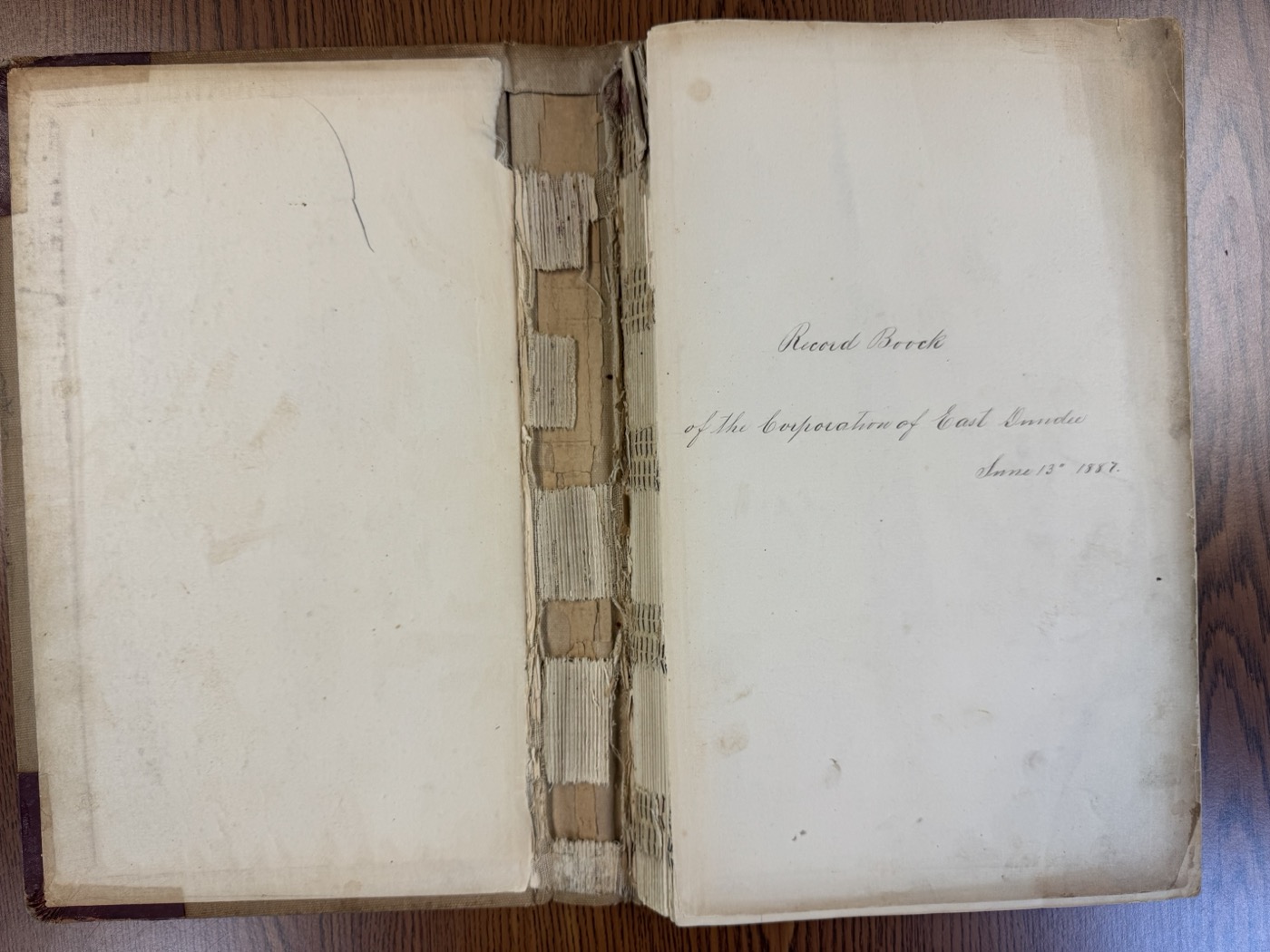
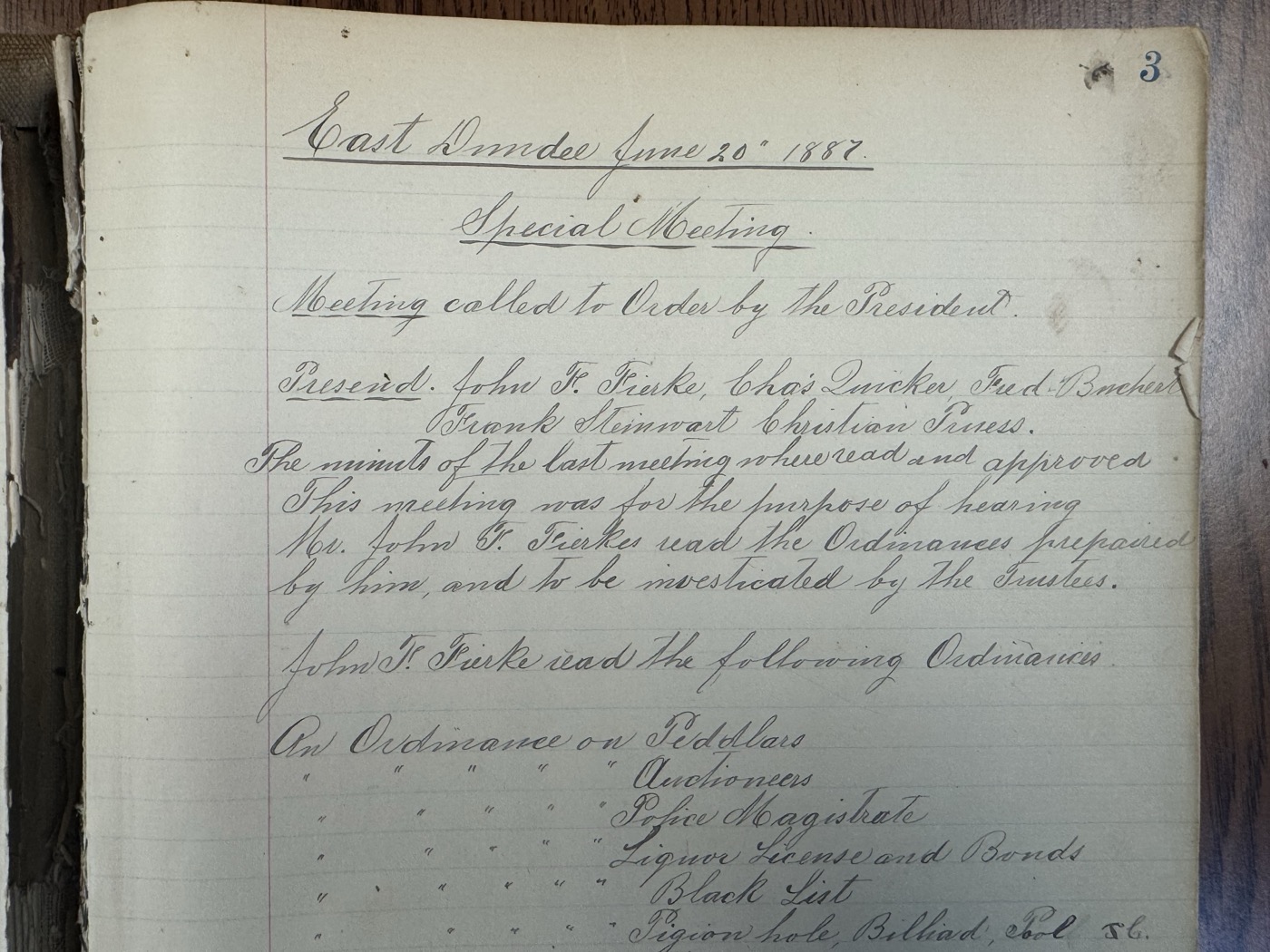
Period: June 1887 – April 1888 Source: Village Record Book of the Corporation of East Dundee (original ledger, pages 1–65)
Overview
The book covers the period from June 1887 through early 1890, making it the primary surviving source for the village's earliest governance. It contains the full text of all founding ordinances, monthly meeting minutes, financial records, and the results of the first annual election held April 17, 1888.
The Founding Officers (June 1887)
| Role | Name |
|---|---|
| President | Fred Buchert |
| Clerk | Charles Duncker |
| Trustees | John H. Funke, Frank Steinwart, Christian Finess, (others) |
The Founding Ordinances (June–July 1887)
Attorney John H. Funke drafted the entire body of founding ordinances, which were read to the board and adopted in a series of Special Meetings in late June and early July 1887. The full texts are preserved in the record book. Ordinances covered:
- Peddlers and Auctioneers
- Police Magistrate — establishing the office
- Liquor Licenses and Bonds — regulating the sale of spirits in quantities under one-eighth barrel; fee structure to be set annually in April; provisions for a "Black List" of persons to whom liquor could not be sold; spouses could petition the village to prohibit sales to a habitually intoxicated family member
- Vagrancy and Misdemeanors
- Police Superintendent on Streets
- Amusements — licensing theatrical performances, concerts, and traveling shows in three classes; circuses and menageries were Class 3
- Keeping Streets in Order / Domestic Animals / Street Labor
- Health Department — establishing a health committee; physicians required to report contagious disease cases (cholera, scarlet fever, small pox, diphtheria) within 24 hours; no dead bodies to be exposed to public prejudice
- Board of Trustees — regular monthly meetings on the first Monday of each month; board members compensated $1 per meeting attended; Clerk received 25 cents per license issued; President served without salary
Notable Events, 1887–1888
Henry Guldan — East Dundee's First Police Officer In June 1887, the village voted $10.00 toward purchasing Henry Guldan an "ivory blue Police suit." Guldan's annual salary was set at approximately $50–58. He is the first documented law enforcement officer in East Dundee history.
The Railroad Flagman Dispute From the earliest months, the board demanded that the Chicago Railroad provide a flagman at the Main Street crossing. The demand was repeated in September 1887 when the Clerk was instructed to notify the railroad that the 60-day notice had expired. The issue appears to have remained unresolved through at least late 1887.
The Oatman Brothers Nuisance A recurring complaint throughout 1887 involved the Oatman Brothers, whose dairy and cheese operations allowed sour hay, buttermilk, and cheese waste to drain into the river and millrace. Neighbors John Emrie and Chas. Shnett formally complained that the offensive smell was a public nuisance. The board repeatedly instructed the Oatman Brothers to abate the problem.
The Engine House In October 1887, the village agreed to purchase an engine house (fire station) from Henry Edwards for $150: $25 paid immediately and $125 due January 1, 1888. This became the village's primary civic gathering space — the venue for the April 17, 1888 election.
Quarantine Cards In September 1887, the board ordered cards printed for epidemic diseases — Scarlet Fever, Small Pox, and Diphtheria — to be posted on homes of infected residents, per the Health Department Ordinance.
The Black List The village maintained an active "Black List" — names of individuals to whom no licensed liquor dealer could sell or give away alcohol. It appears in meeting records as a tool both for controlling problem drinkers and resolving family complaints. One entry records a father successfully petitioning to have his son removed from the list.
Liquor License Revenue In December 1887, five saloon operators each paid $100 for a three-month liquor license: August Hörmann, John Foley, Joachim Lorenz, Henry Rinke, and Chas. Roehl. Under the new elected board (post-April 1888), annual licenses were set at $500 — a five-fold increase.
John H. Funke Moves Away By early 1888, John H. Funke — the attorney who drafted all of the founding ordinances — had relocated outside the village's voting precinct. His departure was noted at the April 2, 1888 Regular Meeting, which also recorded two resulting vacancies on the Finance Committee and as Road Commissioner.
The Incorporation Date Question
This record book provides important evidence in the long-running debate over when East Dundee was formally incorporated. The book's title page reads "Record Book of the Corporation of East Dundee, June 13, 1887" — demonstrating the village was already operating under that formal name before the first entry. The first annual election under an elected President was held April 17, 1888.
The evidence in this ledger suggests:
- The village was functioning as a municipal corporation by at least June 1887
- The April 17, 1888 date likely marks the first formal annual election under state statute
- The "Corporation of East Dundee" name was in continuous use throughout both periods