History
Elgin's growth as a commercial hub accelerated through the middle decades of the nineteenth century. By the time of the publication of The Past and Present of Kane County in 1878, the city supported established banking, manufacturing, and retail enterprises drawing residents and businesspeople from across Kane County and beyond.
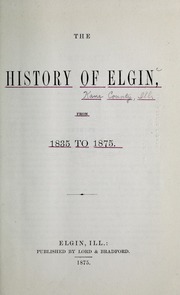
According to The History of Elgin, Kane County, Illinois, 1835 to 1875, Elgin owed much of its early development to James T. Gifford, identified as its first settler and principal founder. Gifford is credited with transforming the area from wild Indian territory into a village of approximately 2,000 inhabitants over roughly fifteen years — "wild Indian territory" here meaning the Potawatomi villages of the Fox River corridor; see Native American Era (pre-1830s). He died in the summer of 1874, and his passing was lamented by the community he had done so much to build. (Source: History of Elgin, Kane County, Illinois, 1835–1875)
By 1875, Elgin's population stood at approximately 2,000. The city was situated five miles south of Dundee, Illinois along the Fox River, connected to Chicago by railroad, and was notable for its evangelical churches, schools, and low prevalence of alcohol establishments. (Source: History of Elgin, Kane County, Illinois, 1835–1875)
The First National Bank of Elgin was formed in 1865 from the merger of the earlier Lawrence, Pease & Town banking firm, reflecting the city's maturing financial infrastructure during the post–Civil War period. (Source: Past and Present of Kane County, Illinois (1878))
The city was also home to monument and stonework trades that served customers throughout Kane County. At least one Elgin-based craftsman, Price, Arwin E., was actively erecting monuments in neighboring communities, including Dundee, Illinois, during this era. (Source: Past and Present of Kane County, Illinois (1878))
By the Gilded Age and into the Progressive Era, Elgin continued to attract businessmen and civic leaders of regional prominence. The city was connected to neighboring communities including Carpentersville, Illinois through the Elgin, Carpentersville & Aurora Railway Company, which operated from at least 1890 to 1901. (Source: Historical Encyclopedia of Illinois and History of Kane County (1904))
Notable Associations
James T. Gifford
Gifford, James T. is identified as the first settler and principal founder of Elgin. According to The History of Elgin, he arrived approximately fifteen years before the village reached a population of roughly 2,000, transforming it from wild Indian territory into a settled community. He died in the summer of 1874, and his death was widely lamented among Elgin's residents. (Source: History of Elgin, Kane County, Illinois, 1835–1875)Arwin E. Price
Price, Arwin E. (born August 29, 1849, Waukesha, Wisconsin) came to Illinois in 1868, locating at Elgin, where he established himself as a manufacturer and dealer in marble, granite, and building stone, and as an importer of Scotch Granite directly from Aberdeen. He erected the soldiers' monument at Elgin and, in the season prior to 1878, erected monuments at Dundee, Illinois for Alfred Edwards, Robert Crichton, and James Winnie. (Source: Past and Present of Kane County, Illinois (1878))Walter L. Pease
Pease, Walter L. (born April 18, 1825, Hartford, Connecticut) arrived in Elgin in November 1857 after earlier careers in the fur trade, general merchandising, and distilling. He became Vice President and subsequently President of the First National Bank of Elgin, served two terms as Mayor of Elgin, and served four years as Alderman. He was a Democrat and a member of the Episcopal church. He married Sarah W. Fowler in 1848. (Source: Past and Present of Kane County, Illinois (1878))William Grote
Grote, William (born November 22, 1849, Winzlar, Hanover, Germany) was a real estate and loans businessman who became a prominent civic and commercial figure in Elgin. He served as Mayor of Elgin in 1891 and again in 1893, and held multiple business leadership positions in Kane County. He served as President of the Elgin, Carpentersville & Aurora Railway Company from 1890 to 1901, a venture that connected Elgin with neighboring Carpentersville, Illinois. (Source: Historical Encyclopedia of Illinois and History of Kane County (1904))Sources
- The Past and Present of Kane County, Illinois (1878). Available at: https://archive.org/details/pastpresentofkan00peir#offset-2519449
- Historical Encyclopedia of Illinois and History of Kane County (1904). Available at: https://archive.org/details/historicalencycl00unse#offset-4605651
- The History of Elgin, Kane County, Illinois, 1835 to 1875 (1875). Available at: https://archive.org/details/historyofelginka00unse#offset-318223