History
The Elgin Dundee Electric Railway operated as part of the broader network of interurban streetcar lines that proliferated throughout northeastern Illinois during the late nineteenth and early twentieth centuries. These lines offered residents of smaller communities like Dundee and Carpentersville relatively affordable and frequent access to larger commercial centers such as Elgin.
The Accident of August 1902
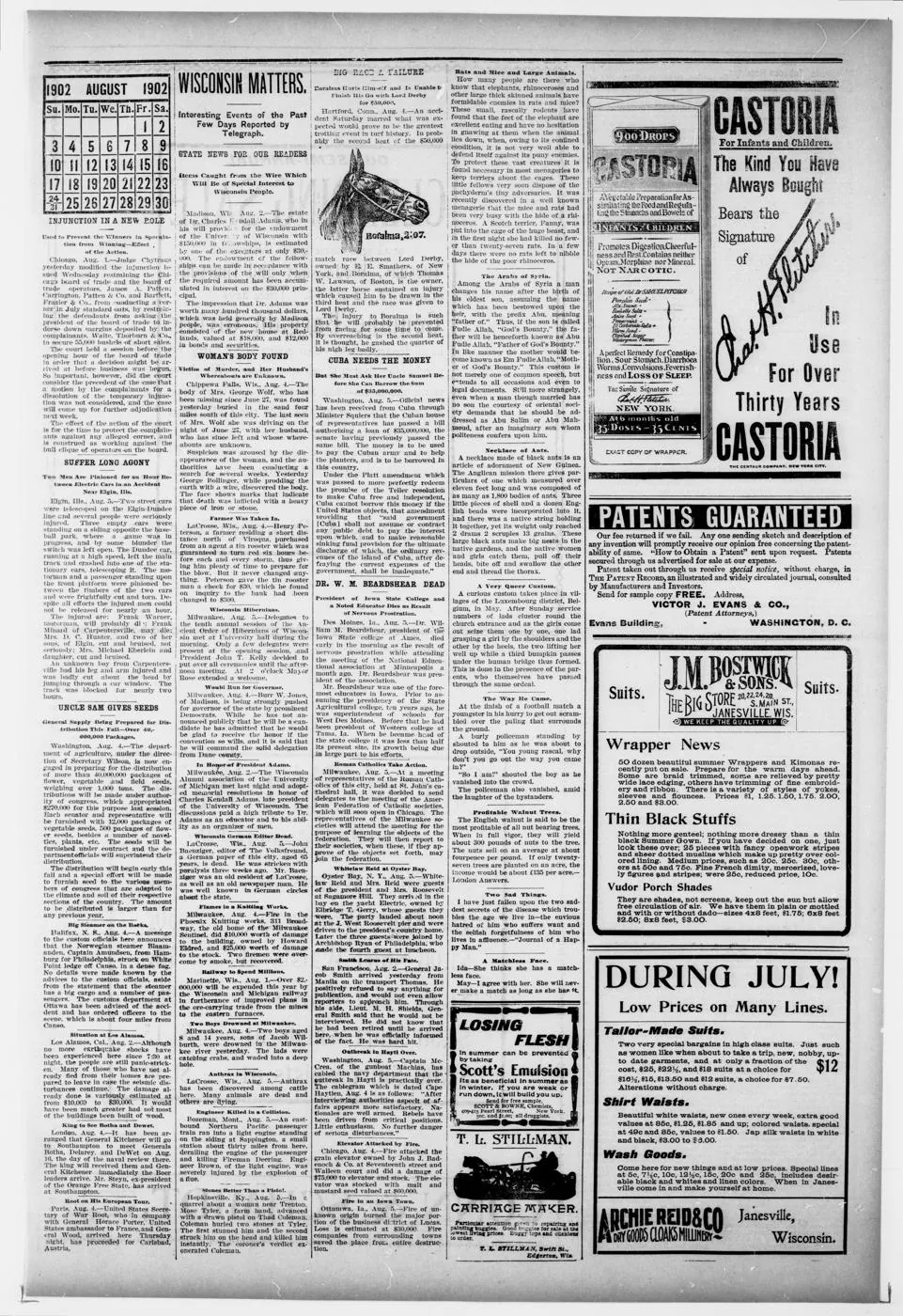
On or about August 5, 1902, a serious collision occurred on the Elgin-Dundee line that drew regional attention. According to a report published in The Wisconsin Tobacco Reporter (Edgerton, Wis.) on August 8, 1902, two streetcars telescoped when a Dundee-bound car traveling at high speed left the main track and crashed into a stationary car. (Source: wisconsin-tobacco-reporter-1902-08-08)
The immediate cause of the accident was reportedly a switch left open by blunder, diverting the moving car off the main line. At the time of the collision, three empty cars were standing on a siding opposite a baseball park — the precise location of that park within the Dundee area is not confirmed by currently available sources. The impact was severe enough to trap two men between the cars for nearly an hour, and the track remained blocked for approximately two hours following the accident. (Source: wisconsin-tobacco-reporter-1902-08-08)
The injured parties included:
- Frank Warner, the motorman, who was pinioned between the cars for nearly an hour. Reports at the time indicated he would probably die from his injuries. (Source: wisconsin-tobacco-reporter-1902-08-08)
- Frank Minajd, a passenger from Carpentersville, who was also trapped between the cars and whose condition was reported as potentially fatal. (Source: wisconsin-tobacco-reporter-1902-08-08)
- Mrs. D. C. Hunter, a passenger from Elgin, who was cut and bruised but not seriously injured. (Source: wisconsin-tobacco-reporter-1902-08-08)
- Mrs. Michael Eberlein, who sustained cuts and bruises. (Source: wisconsin-tobacco-reporter-1902-08-08)
- An unidentified boy from Carpentersville who injured his leg and arm and was badly cut about the head, reportedly after jumping through a car window during the collision. (Source: wisconsin-tobacco-reporter-1902-08-08)
Notable Associations
- Carpentersville — Several passengers aboard the car at the time of the 1902 accident originated from Carpentersville, suggesting the line served communities beyond the immediate Elgin-Dundee corridor, or that connecting travel was common.
- Elgin — The western terminus of the line; at least one injured passenger, Mrs. D. C. Hunter, is identified as being from Elgin.
- Baseball park, Dundee area — An unidentified baseball park is mentioned in proximity to the accident site, opposite the siding where three empty cars were standing at the time of the collision. The park's name and exact location have not been confirmed.
Sources
- The Wisconsin Tobacco Reporter (Edgerton, Wis.), August 8, 1902, Image 3. Library of Congress, Chronicling America. https://www.loc.gov/resource/sn86086586/1902-08-08/ed-1/?sp=3