History
By the close of the nineteenth century, the Dundee area had developed into a notable agricultural and light-industrial center within Kane County. According to the Historical Encyclopedia of Illinois and History of Kane County (1904), dairy farming was the principal industry of the surrounding region, a fact reflected in the presence of two large milk-condensing plants operating within the town. A cheese factory also served the local dairy economy.
The Fox River provided good water power, supporting both flour mills and saw mills in the area. Additional manufacturing activity included brick and tile works. An extensive nursery operated in the community, suggesting the region's soil and climate were considered favorable for horticultural enterprise.
The town was served by two banks and six churches by the turn of the twentieth century, indicating a settled and reasonably prosperous community. A handsome high school building and a public library spoke to investment in civic and educational infrastructure. One weekly newspaper was published locally.
Population figures recorded in the encyclopedia show steady growth: 2,023 residents in 1890, rising to 2,765 by 1900 — a gain of roughly 37 percent over the decade. (Source: Historical Encyclopedia of Illinois and History of Kane County (1904))
⚠️ CONTRADICTION: The 1904 encyclopedia entry on Dundee records a combined or township-level population of 2,023 (1890) and 2,765 (1900) as noted above. However, a separate section of the same publication provides village-level census figures showing East Dundee's population at 759 in 1850 and 1,348 in 1900, with West Dundee at 911 (1850) and 1,170 (1900), and Carpentersville at 591 (1850) and 1,417 (1900). Additionally, Dundee Township itself (excluding the incorporated villages) recorded 1,374 residents in 1850, declining to 1,040 by 1900. These village-level figures, summed across incorporated places, do not reconcile straightforwardly with the higher aggregate figures cited in the encyclopedia's main Dundee entry; both sets of figures are preserved here pending further clarification. (Source: Historical Encyclopedia of Illinois and History of Kane County (1904))
Dundee is also noted as a voting precinct on the first division map of Kane County, indicating its early administrative significance within the county's civic organization. The broader township was served by rail connections, with Lily Lake station located approximately six miles easterly of the area. (Source: Historical Encyclopedia of Illinois and History of Kane County (1904))
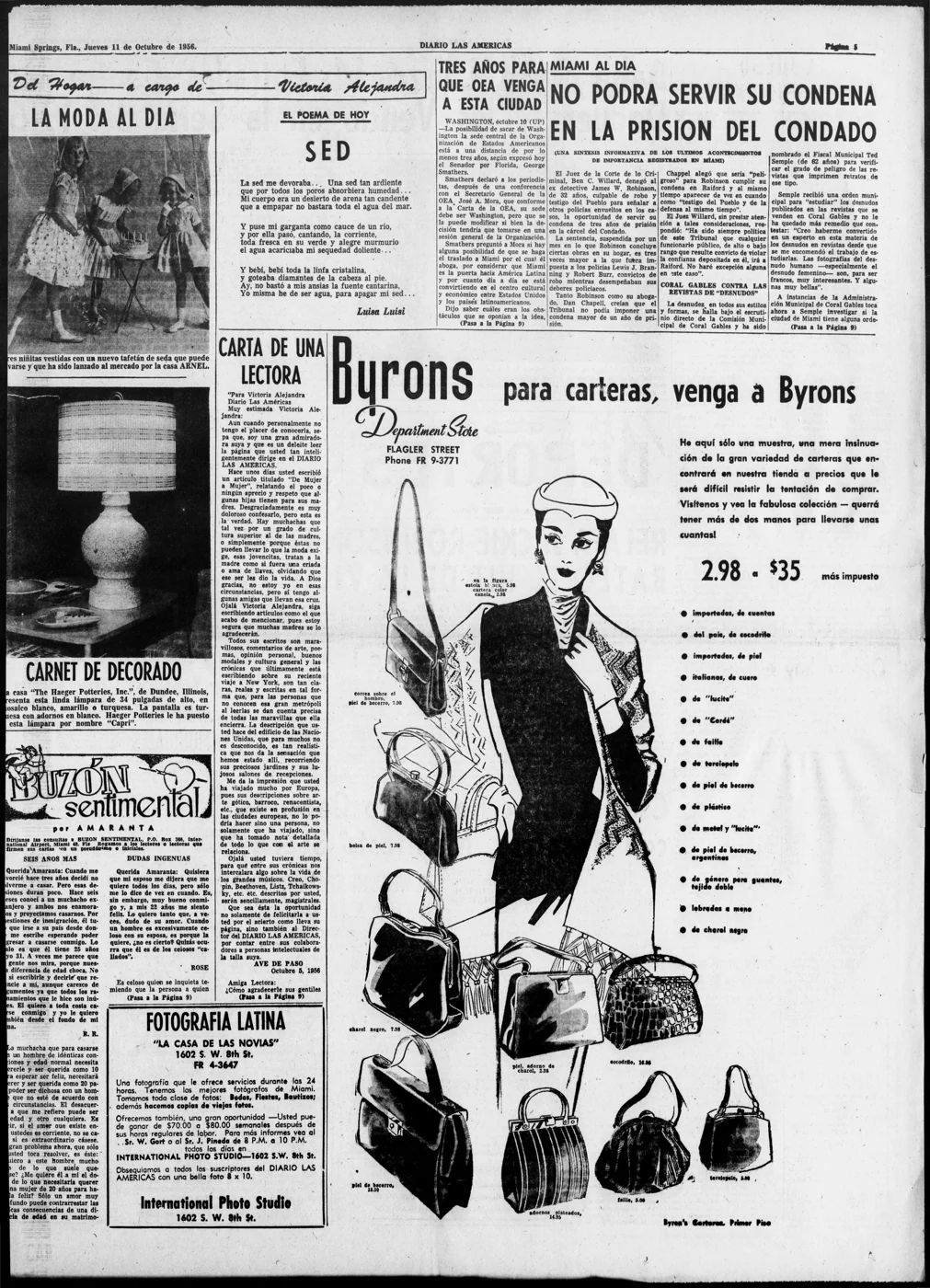
By the mid-twentieth century, Dundee was home to The Haeger Potteries, Inc., a ceramics and home furnishings manufacturer. An advertisement placed in the Spanish-language Miami newspaper Diario las Américas on October 11, 1956, promoted the company's decorative "Capri" lamp — a 34-inch lamp available in white, yellow, or turquoise mosaic finishes, with a turquoise shade bearing white ornamental details. The appearance of a Dundee manufacturer's advertisement in a Miami-area Spanish-language publication suggests Haeger's products had distribution reach beyond the immediate region by the 1950s. (Source: Diario las Américas, October 11, 1956, via Library of Congress Chronicling America)
Founding and Incorporation
The land that became East Dundee was platted in 1837 for Thomas Deweese, who had laid claim to a large part of the area — newcomers who settled there without knowing of his claim were forced to pay him or were moved out by men he hired. Deweese built a gristmill in 1837 and was soon after responsible for the area's first bridge. (Thomas Deweese is separately recorded, per Joslyn's 1908 History of Kane County, among the township's early Scotch-Irish-English settlers alongside Jesse Oatman and A. R. Dempster — worth reconciling the two accounts of his role.) In the 1850s a large group of Lutheran Germans settled the area and built their own church, a divergence from their largely Scottish neighbors across the river in West Dundee, Illinois that shaped the two villages' separate identities. East Dundee incorporated in 1887, a date that also matches the village's own founding-era record book. (Source: Encyclopedia of Chicago, "East Dundee, IL," Marilyn Elizabeth Perry, 2004/2005)
A brickyard began operating in 1852 using clay dug from the riverbank. D. H. Haeger became part owner in 1871 — the same year the village incorporated — and was sole owner within a year, having expanded into tile. After the Chicago Fire of 1871, the yard shipped bricks into the city to help rebuild. By the 1920s production had expanded to teaware, luncheonware, and Royal Hickman crystal and glassware. Haeger Potteries exhibited a full working plant at the 1934 Century of Progress Exposition in Chicago, where souvenir pottery was made on the spot for visitors. By 1985 the company — by then passed to Haeger's great-grandchildren — employed 200 workers, most of them women, and by the 1990s had a national sales base drawing shoppers to its factory, especially during its summer tent sale. (Source: Encyclopedia of Chicago, "East Dundee, IL")
The Mall That Never United the Dundees
Referendums to merge East and West Dundee failed twice, in opposite directions: the 1956 vote was approved by East Dundee but rejected by West Dundee, and the 1962 vote saw the outcome reverse. East Dundee, hemmed in by the river to its west and Hoffman Estates to its east, never captured the economic benefit of Spring Hill Mall (built on former D. Hill Nursery Co., Inc.|D. Hill Nursery land in West Dundee, completed 1980) despite its proximity. East Dundee did later annex the Rockroad Industrial Park (1984–85) and add the Spring Hill Ford dealership and a shopping center around 1990. (Source: Encyclopedia of Chicago, "East Dundee, IL")
Population (Encyclopedia of Chicago, 20th century)
| Year | Population | Foreign born | Males per 100 females |
|---|---|---|---|
| 1900 | 1,417 | — | — |
| 1930 | 1,341 | 16.4% | 105 |
| 1960 | 2,221 | — | 102 |
| 1990 | 2,721 | 3.0% | 100 |
| 2000 | 2,955 | 6.7% | 96 |
Notable Associations
- West Dundee — The sister village across the Fox River, with which East Dundee shares the broader Dundee community identity. West Dundee recorded a population of 911 in 1850 and 1,170 in 1900.
- Fox River — The river that defines the geography of the Dundee area and historically provided water power for local mills.
- Kane County — The county in which East Dundee is situated and within whose civic and legal structures it operates.
- Dundee Township — The township encompassing East Dundee, West Dundee, and Carpentersville, described as well-developed with multiple highways and highly cultivated dairy farms.
- Carpentersville — A neighboring village within Dundee Township, recording a population of 591 in 1850 and 1,417 in 1900.
- The Haeger Potteries, Inc. — A ceramics and decorative home furnishings manufacturer located in Dundee, Illinois, advertising nationally and in Spanish-language media by at least 1956.
Municipal Incorporation
The oldest surviving village record book — Record Book of the Corporation of East Dundee, June 13, 1887 — documents the village's earliest governance in its own hand. The book opens with