Founding date and name discrepancy. The Encyclopedia of Chicago's "West Dundee, IL" entry states the nursery was "founded in 1855 by William Hill," specializing first in fruit trees before expanding to evergreens — a full founding date this wiki didn't previously have, but a different first name than every other source used to build this page. Whether "D. Hill," "Dr. Hill," and "William Hill" are the same person, a father-son succession, or a genuine name confusion in one of the sources is not yet resolved. Flagging per `docs/name-spelling-register.md` conventions rather than merging silently. The Encyclopedia entry also adds that the nursery grew to 900 acres and survived the Great Depression by running a cattle-feed operation through World War II, with seasonal workers commuting from Chicago by electric car. (Source: Encyclopedia of Chicago, "West Dundee, IL," Marilyn Elizabeth Perry, 2004/2005)
Known Activities
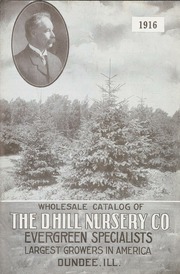
D. Hill operated what the company itself described as the largest evergreen nursery in America, situated on well-drained, fertile soil in the Fox River Valley near Dundee. The nursery served wholesale trade customers and published catalogues advertising its stock of evergreens and other nursery goods. (Source: Catalogue of Evergreens (D. Hill Nursery Co., Dundee, Ill., c. 1895))
A distinguishing feature of Hill's operation was his practice of growing evergreens from seed rather than harvesting them from the wild — a point he emphasized in his 1895 catalogue. Hill argued that nursery-grown trees were superior to wild-harvested stock, citing his own trials in which wild evergreens — including American Arbor Vitae, Balsam Fir, White Pine, and Swamp Spruces transplanted from northern forests — achieved a survival rate of only approximately 3% over six years. He credited careful root cultivation as the essential factor in evergreen success. (Source: Catalogue of Evergreens (D. Hill Nursery Co., Dundee, Ill., 1895))
The 1895 catalogue offered a broad range of stock beyond evergreens, including hedge plants, shade and ornamental trees, flowering shrubs, roses, fruit trees, and small fruits, and included sections on planting instructions and customer testimonials. The catalogue was printed in both German and English, reflecting the linguistic diversity of the nursery's customer base. At that time, Hill offered free boxing and packing for trees under three feet in height, and a sample order of 200 two-year-old evergreens in ten varieties was available for $2.00 prepaid. The nursery also had 50,000 second-class Scotch Pine trees available — described as 34 to 44 feet tall — priced at $15.00 per hundred or $125.00 per thousand. (Source: Catalogue of Evergreens (D. Hill Nursery Co., Dundee, Ill., 1895))
The 1895 catalogue also included a section on tree seeds, with pricing listed by ounce, pound, and 100-pound quantities. The seed inventory encompassed both evergreen species — including firs, spruces, cedars, and junipers — and deciduous species such as maple, oak, hickory, and locust. Seeds were collected from a range of geographic origins, including Wisconsin, the Black Hills, Scotland, Japan, Siberia, and the Pacific Coast. Some seeds, including Black Locust, were noted as native to the Dundee area. The nursery guaranteed that its seeds were new crop stock, largely of their own collecting. (Source: Catalogue of Evergreens (D. Hill Nursery Co., Dundee, Ill., 1895))
Hill exhibited evergreens at the World's Fair — likely the 1893 World's Columbian Exposition in Chicago, also known as the White City — where the display reportedly received praise for its landscape and artistic arrangement. Following the exhibit, Hill received nearly 1,000 letters of compliment from patrons across the United States, Canada, England, and France. In connection with spring 1896 orders of $5.00 or more, Hill proposed offering an enlarged lithograph — 24 by 40 inches, printed in six colors — depicting his World's Fair exhibit, with the cost of producing the lithograph estimated at between $3,000 and $5,000. (Source: *Catalogue of Evergre