Date & Context
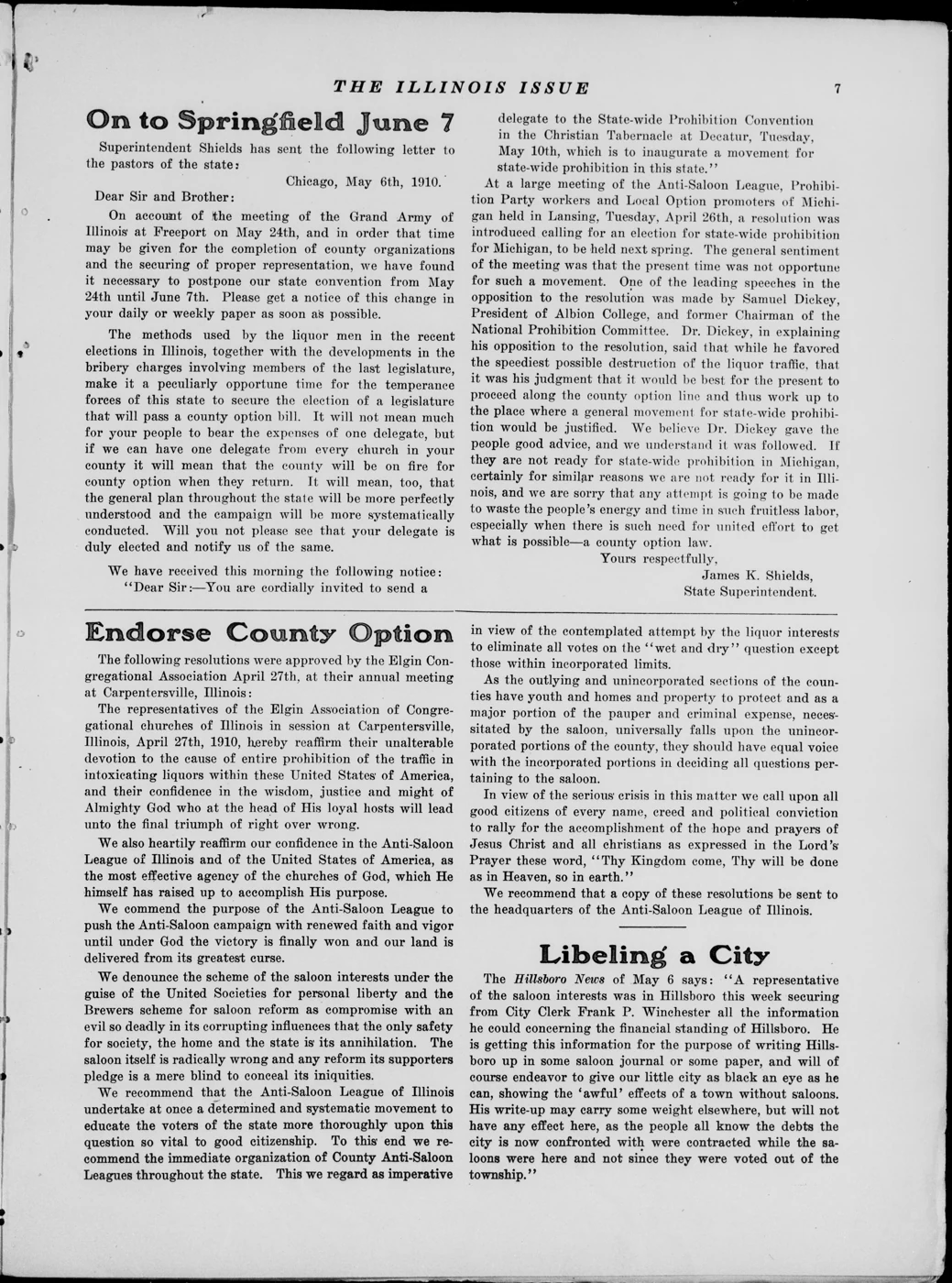
The annual meeting convened on April 27, 1910, in Carpentersville, Illinois, a community within the geographic reach of the Elgin Congregational Association. The precise meeting venue within Carpentersville is not recorded in the available source. (Source: the-illinois-1910-05-13-image-7)
The meeting occurred during a period of considerable organizing activity among Illinois temperance advocates. Just one day prior, on April 26, the Michigan Anti-Saloon League held a meeting in Lansing at which a resolution calling for a state-wide prohibition election was debated. That resolution drew notable opposition from Samuel Dickey, President of Albion College and former Chairman of the National Prohibition Committee, who argued that county option legislation represented the more practical and effective path toward eventual state-wide prohibition. The Illinois temperance movement appears to have been watching developments in Michigan closely. (Source: the-illinois-1910-05-13-image-7)
Around the same period, a State-wide Prohibition Convention was scheduled for May 10, 1910, to be held at the Christian Tabernacle in Decatur, Illinois, with the aim of inaugurating a movement for state-wide prohibition. This convention represented a more aggressive approach than the county option strategy favored by some temperance leaders. (Source: the-illinois-1910-05-13-image-7)
Separately, a State Temperance Convention originally scheduled for May 24, 1910, was postponed to June 7, 1910, and relocated to Springfield, Illinois. State Superintendent James K. Shields communicated the change by letter to pastors, citing a scheduling conflict: the Grand Army of Illinois was meeting at Freeport on May 24, which would have drawn away potential attendees. (Source: the-illinois-1910-05-13-image-7)
Participants
James K. Shields
Shields served as State Superintendent of the temperance organization in 1910. He took responsibility for communicating the postponement of the state convention to pastors across Illinois, indicating an active administrative role in coordinating temperance efforts throughout the region. His letters to clergy suggest that churches — including Congregational bodies such as the Elgin Association — were considered central organizing nodes for the temperance movement. (Source: the-illinois-1910-05-13-image-7)Samuel Dickey
Dickey, President of Albion College in Michigan and formerly Chairman of the National Prohibition Committee, was not a direct participant in the Elgin meeting, but his arguments at the Michigan Anti-Saloon League meeting on April 26 are reported in the same source. He reportedly spoke against a resolution for immediate state-wide prohibition, advocating instead for county option as a practical stepping stone. His position reflects the strategic divisions within the broader prohibitionist movement at this time. (Source: the-illinois-1910-05-13-image-7)Elgin Congregational Association Members
The membership of the association at the time of the 1910 annual meeting is not individually named in the available source. The association drew from Congregational churches in the Elgin area of northern Illinois, and its geographic territory included communities such as Carpentersville, Illinois. (Source: the-illinois-1910-05-13-image-7)Significance
The resolutions passed at the April 27 meeting reflect the Elgin Congregational Association's formal alignment with the temperance cause during the Progressive Era, a period when prohibition advocacy was gaining organized momentum across Illinois and the nation. By passing language reaffirming "devotion to entire prohibition of intoxicating liquors traffic in the United States," the association took a notably absolute stance at a moment when the movement itself was internally divided over strategy. (Source: the-illinois-1910-05-13-image-7)
The choice of Carpentersville as the meeting location — rather than Elgin itself — may reflect the association's practice of rotating annual meetings among member congregations, though this cannot be confirmed from the available source alone.
The meeting's timing, one day after the Michigan Anti-Saloon League debate and roughly two weeks before the Decatur prohibition convention, places it within a concentrated period of temperance organizing in the spring of 1910. Whether the Elgin Association's resolutions were coordinated with or influenced by these other events is not established by the source. (Source: the-illinois-1910-05-13-image-7)
Sources
- The Illinois (Chicago, Ill.; Downers Grove, Ill.), May 13, 1910, Image 7. Library of Congress, Chronicling America. https://www.loc.gov/resource/sn2008060405/1910-05-13/ed-1/?sp=7