Date & Context
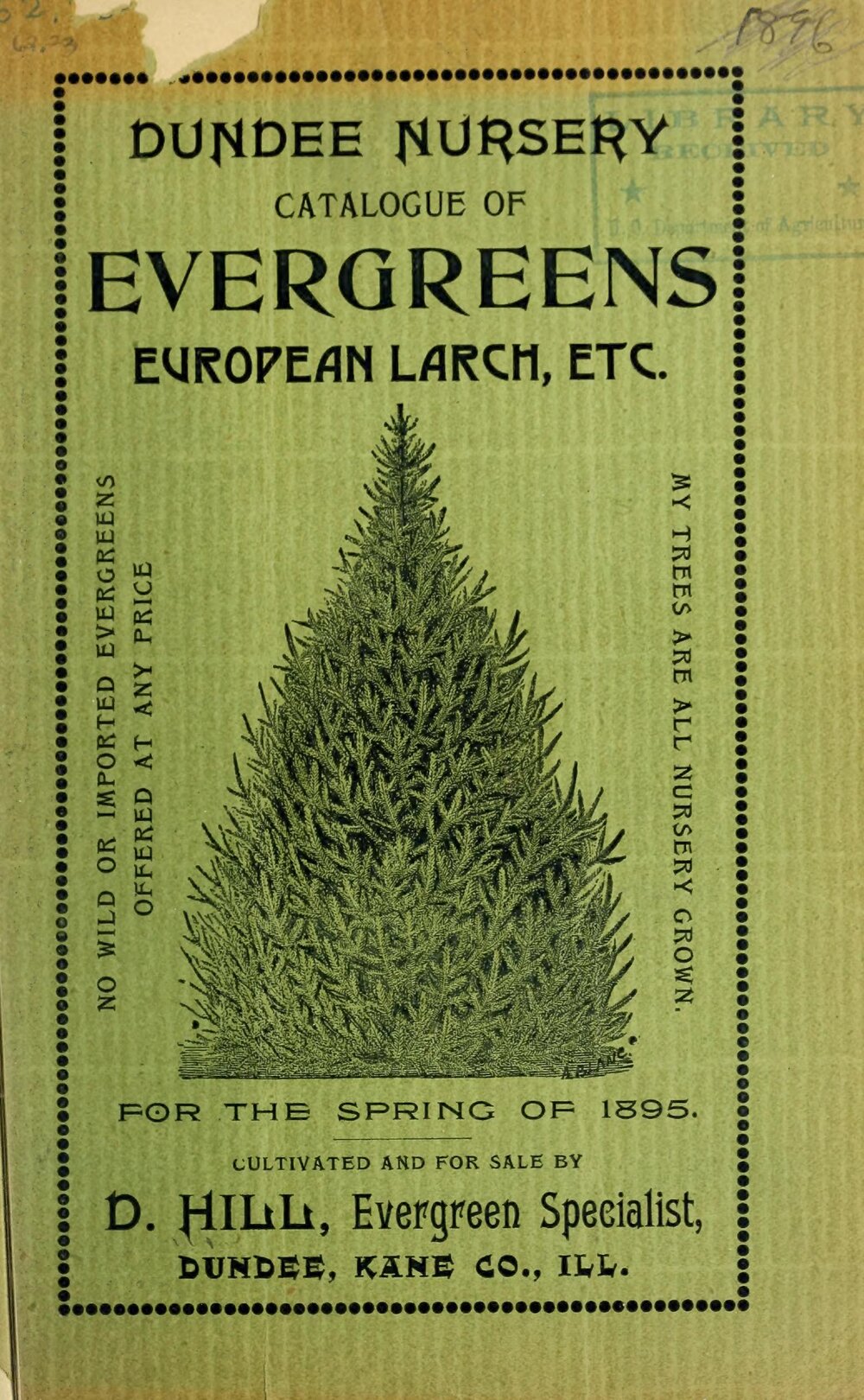
The catalogue was published in 1895, during a period of significant agricultural and horticultural commerce in the Fox River Valley. D. Hill Nursery was located in Dundee, Illinois, in Kane County, and specialized in tree seeds rather than nursery stock alone. The 1895 catalogue listed seeds by common and botanical name, with pricing given per ounce, per pound, and per hundred-pound lot — suggesting the nursery served both small buyers and wholesale customers. (Source: Catalogue of Evergreens (D. Hill Nursery Co., Dundee, Ill., 1895))
The nursery described its seeds as "new crop," and the catalogue notes that much of the stock was of the nursery's own collecting — a claim intended to distinguish the operation from resellers dealing in older or less reliably sourced material. (Source: Catalogue of Evergreens (D. Hill Nursery Co., Dundee, Ill., 1895))
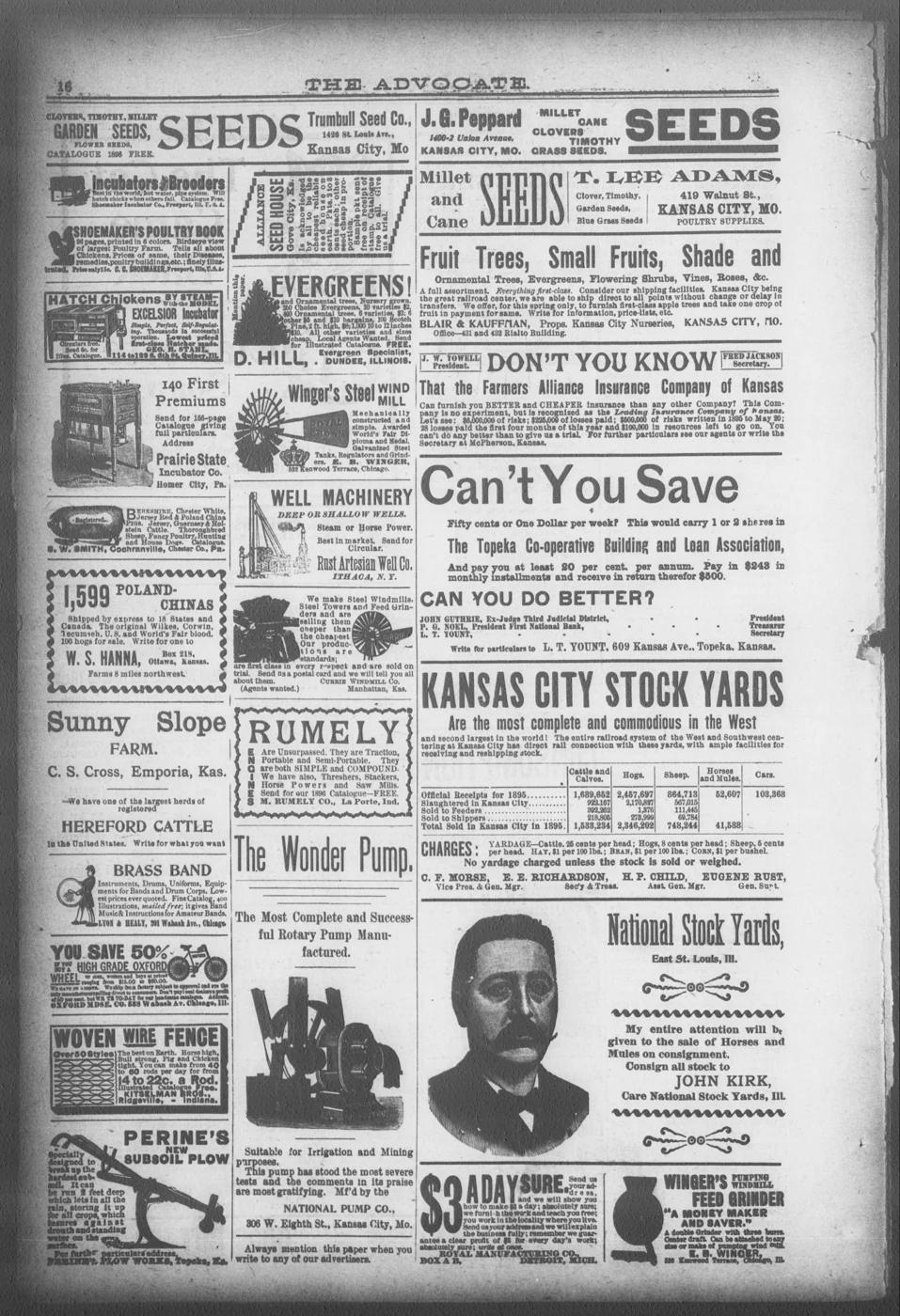
By March 25, 1896, D. Hill Nursery was placing advertisements in The Advocate of Topeka, Kansas, illustrating that its marketing extended well beyond the regional press. The advertisement offered specific retail and wholesale price points for nursery stock — distinct from seed pricing — indicating the business had expanded or diversified its offerings in the year following the catalogue's publication. (Source: The Advocate (Topeka, Kan.), March 25, 1896, Image 16, Library of Congress, Chronicling America)
Participants
- D. Hill — Proprietor of D. Hill Nursery, active in 1895 and 1896. Little additional biographical detail has been established from these sources alone; the operator's full given name remains partially obscured in surviving records. (Source: Catalogue of Evergreens (D. Hill Nursery Co., Dundee, Ill., 1895); The Advocate (Topeka, Kan.), March 25, 1896)
Significance
The 1895 catalogue documents D. Hill Nursery as a commercially active and geographically wide-ranging operation at the close of the nineteenth century. The inclusion of seeds collected from Wisconsin, the Black Hills, Scotland, Japan, and Siberia suggests the nursery maintained supplier relationships well beyond the local region, and points to Dundee as a node in broader national and international horticultural trade networks during the Gilded Age.
Of local note, certain seeds — including Black Locust — were identified in the catalogue as native to the Dundee area, indicating that the nursery also drew on the immediate landscape of Kane County as a seed source. (Source: Catalogue of Evergreens (D. Hill Nursery Co., Dundee, Ill., 1895))
The March 1896 advertisement in The Advocate further underscores the nursery's national commercial ambitions. The advertisement offered 200 choice evergreens in 10 varieties for $2, and ornamental trees in lots of 2,000 to 4,000 in 6 varieties. Specific bargain pricing included 100 Scotch Pine trees at two feet high for $1, and 1,000 trees at 10–12 inches for $10. The nursery also sought local agents and offered an illustrated catalogue free of charge — suggesting a deliberate strategy of distributed retail sales beyond direct mail order. (Source: The Advocate (Topeka, Kan.), March 25, 1896, Image 16, Library of Congress, Chronicling America)
The catalogue survives as a primary source for the early history of what would become one of the region's more enduring horticultural businesses, and offers a snapshot of commercial tree cultivation in northeastern Illinois in the 1890s.
Sources
- Catalogue of Evergreens, D. Hill Nursery, Dundee, Illinois, 1895. Available via Internet Archive: https://archive.org/details/catalogueofeverg1895dund#offset-25035
- The Advocate (Topeka, Kan.), March 25, 1896, Image 16. Library of Congress, Chronicling America: https://www.loc.gov/resource/sn85032018/1896-03-25/ed-1/?sp=16