Date & Context
The kidnapping occurred approximately thirteen days before the reporting date of September 20, 1928, placing the abduction in early September 1928. The case unfolded during the Jazz Age / Interwar Period, a time when high-profile kidnappings for ransom were a growing criminal concern across the United States, particularly in and around major metropolitan areas and their surrounding communities.
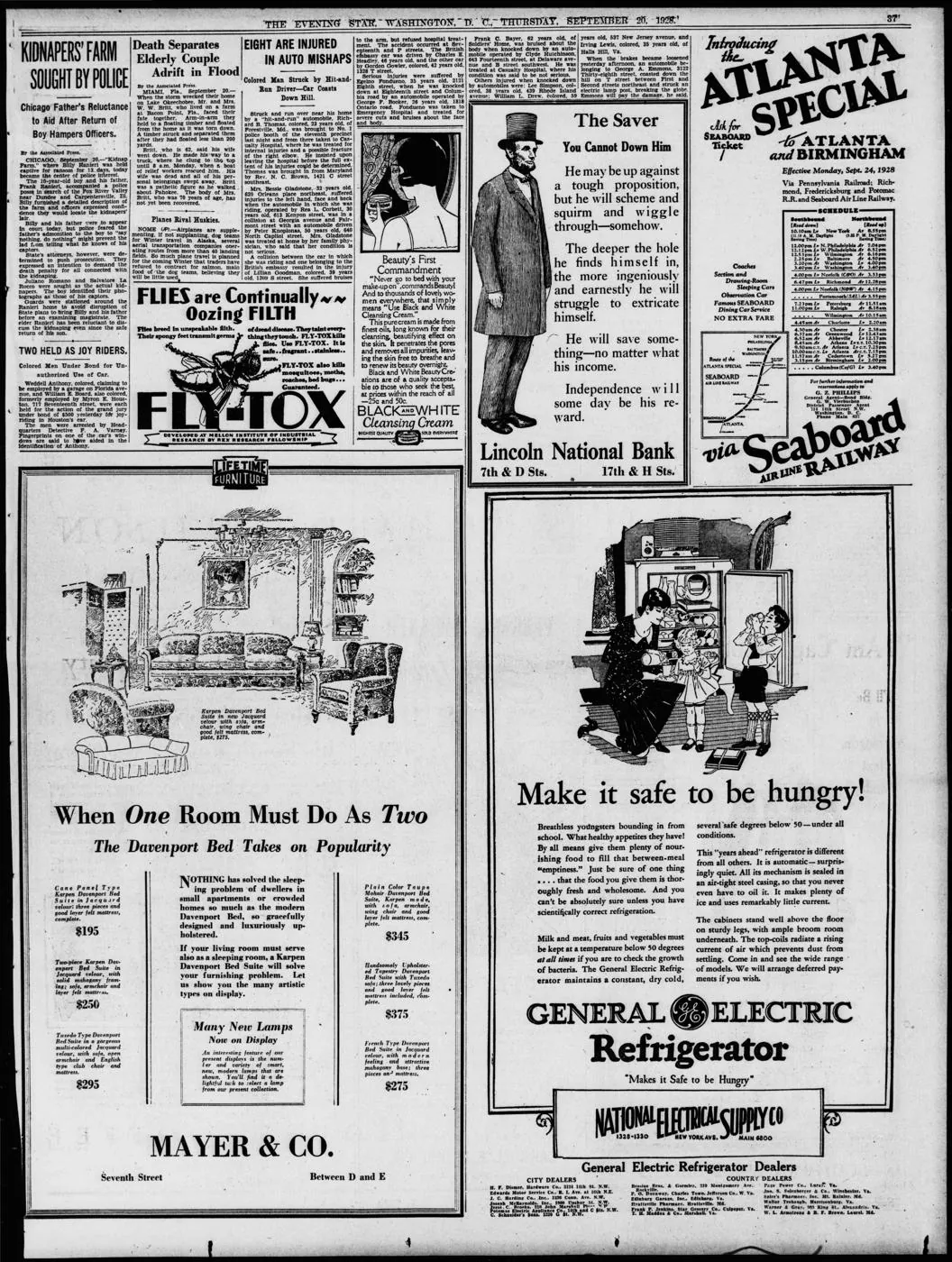
The Fox River Valley, situated between the Kane County towns of Dundee and Carpentersville, provided the backdrop for the police search. The area's mix of farmland and relative remoteness made it plausible, according to investigators, as a location where captors could conceal a child for an extended period without immediate detection. (Source: evening-star-1928-09-20-image37)
Guards were reportedly stationed at the Ranieri home during the investigation, suggesting that authorities considered the family's security an ongoing concern even after Billy's return. (Source: evening-star-1928-09-20-image37)
Participants
Billy Ranieri (victim)
Billy Ranieri, age ten, was the kidnapping victim. According to reporting from the Evening Star, he was held captive for thirteen days before being released or recovered. Following his return, Billy reportedly provided police with a detailed description of the farm where he had been held, and he accompanied officers and his father into the Fox River Valley to assist in identifying the location. He also identified suspects Juliano Romano and Salvatore LaRocco from photographs shown to him by investigators. (Source: evening-star-1928-09-20-image37)Frank Ranieri (father)
Frank Ranieri, Billy's father, accompanied his son and police during the farm search. His cooperation with investigators was reportedly complicated by an instruction he had given Billy to "say nothing, do nothing," which, according to the Evening Star, hampered the police investigation to some degree. The reasons behind Frank Ranieri's reluctance to fully aid police are not detailed in the available source material. (Source: evening-star-1928-09-20-image37)Juliano Romano (suspect)
Juliano Romano was identified by Billy Ranieri from photographs as one of the suspected kidnappers. His whereabouts at the time of the September 20, 1928 report are not specified in the available source. (Source: evening-star-1928-09-20-image37)Salvatore LaRocco (suspect)
Salvatore LaRocco was similarly identified by Billy Ranieri from photographs as a suspected kidnapper. No further biographical details appear in the available source material. (Source: evening-star-1928-09-20-image37)State's Attorneys
Illinois state's attorneys were reportedly prepared to demand the death penalty for those connected to the kidnapping. The specific individuals holding these offices at the time have not been confirmed from this source. (Source: evening-star-1928-09-20-image37)Significance
The 1928 Billy Ranieri kidnapping is notable in the local history of the Fox River Valley region for several reasons.
Local geography as crime scene. The search for the so-called "kidnap farm" near Dundee and Carpentersville brought investigators and national press attention to the rural character of Kane County's Fox River Valley communities. The Washington, D.C. Evening Star carrying the story on its thirty-seventh page indicates the case had reached a national readership, an unusual distinction for a small Illinois community at the time.
Child witness. Billy Ranieri's role in the investigation — identifying suspects by photograph and guiding police through the countryside — was apparently central to the case. His detailed recollection of the farm, despite his age and the ordeal he had endured, was treated as a key investigative asset.
Family complications. Frank Ranieri's instruction to his son to remain silent is a documented complication in the record and raises questions, unresolved by the available source, about the family's relationship to the criminal networks allegedly involved. Such reluctance was not uncommon in kidnapping cases of the era, where victims' families feared reprisal or had complicated ties to perpetrators.
Legal severity. The state's attorneys' stated intention to pursue the death penalty reflects the serious legal climate surrounding kidnapping in Illinois during this period, anticipating by several years the federal Lindbergh Law of 1932, which made interstate kidnapping a capital offense under federal law.
Sources
- evening-star-1928-09-20-image37 — Evening Star (Washington, D.C.), September 20, 1928, Image 37. Library of Congress, Chronicling America. Available at: https://www.loc.gov/resource/sn83045462/1928-09-20/ed-1/?sp=37
This page was created for The Kiln, the local history wiki for East Dundee, Illinois. If you have additional information about the Ranieri kidnapping, the Fox River Valley farm search, or the individuals named here, please contribute to this page.