Date & Context
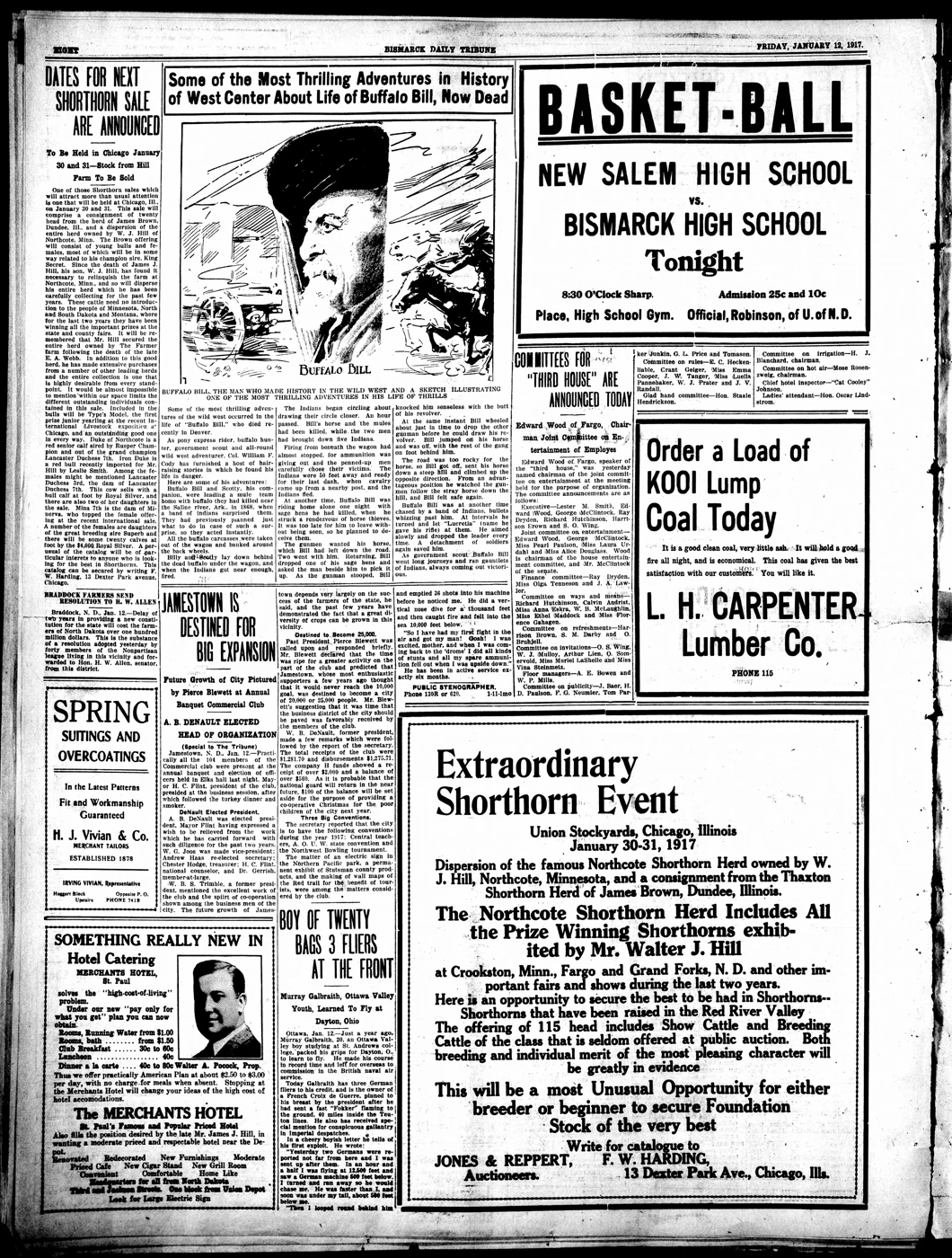
The sale took place on January 30–31, 1917, at Chicago, Illinois. It was announced in the Bismarck Tribune (Bismarck, North Dakota) on January 12, 1917, suggesting the event was promoted across a broad regional market well in advance. (Source: bismarck-tribune-1917-01-12-p8)
The year 1917 placed this sale squarely within the WWI Era, a period of heightened agricultural activity across the Midwest. Demand for livestock — including beef cattle — was elevated by wartime food supply pressures, which may help explain why a sale of this kind attracted notice as far as the Northern Plains press.
Dundee, Illinois, at the time an unincorporated community along the Fox River, had an agricultural character typical of Kane County. James Brown's operation appears to have been a serious breeding enterprise rather than a general farm, given the explicit pedigree connection to King Secret cited in the announcement.
Participants
James Brown (Dundee, Illinois)
Brown was the local figure of primary relevance to East Dundee history. He is identified in the source as a cattle breeder and farm owner based in Dundee, Illinois, consigning twenty head of Shorthorn cattle — young bulls and females — to the Chicago sale. The animals were reportedly related to the champion sire King Secret, indicating a deliberate breeding program oriented toward show and sale quality stock. No further biographical details about Brown are confirmed from this source alone. (Source: bismarck-tribune-1917-01-12-p8)W. J. Hill (Northcote, Minnesota)
Son of the prominent railroad magnate James J. Hill, W. J. Hill was dispersing his entire herd at the same sale, reportedly following his father's death. Hill's cattle had reportedly won major prizes at state and county fairs across Minnesota, North Dakota, South Dakota, and Montana during the preceding two years. His participation gave the sale considerable profile regionally. Hill's farm was located at Northcote, Minnesota, and is not directly connected to East Dundee history beyond appearing alongside the Brown consignment in the same announcement. (Source: bismarck-tribune-1917-01-12-p8)F. W. Harding (Chicago, Illinois)
Harding is listed in the source as the coordinator for the sale catalog, with an address of 13 Dexter Park Avenue, Chicago. His role appears to have been administrative or promotional rather than that of a breeder or buyer. (Source: bismarck-tribune-1917-01-12-p8)Significance
For local historians, this sale record offers a rare, dated, and named reference to organized livestock breeding in Dundee, Illinois during the WWI era. The fact that James Brown's consignment was considered noteworthy enough to appear in a North Dakota newspaper alongside a high-profile herd dispersal by a member of the Hill family suggests that his Shorthorn operation had some standing in regional breeding circles.
The connection to King Secret — described as a champion sire — indicates that Brown's herd was not incidental farm stock but part of the competitive Shorthorn breeding culture that flourished in the upper Midwest during the early twentieth century. Shorthorn cattle were prized at this time for their dual-purpose qualities (beef and dairy), and pedigree sales of this kind were a significant economic and social institution in agricultural communities.
No records have yet been identified in local Kane County sources to corroborate or expand upon Brown's operation, and details of his landholding, farm location within Dundee, or subsequent activities remain unknown at this time. Further research in Kane County agricultural records, census data, and local newspaper archives may help clarify his place in the community.
Sources
- bismarck-tribune-1917-01-12-p8 — The Bismarck Tribune (Bismarck, N.D.), January 12, 1917, Image 8. Library of Congress, Chronicling America. URL: https://www.loc.gov/resource/sn85042243/1917-01-12/ed-1/?sp=8