Date & Context
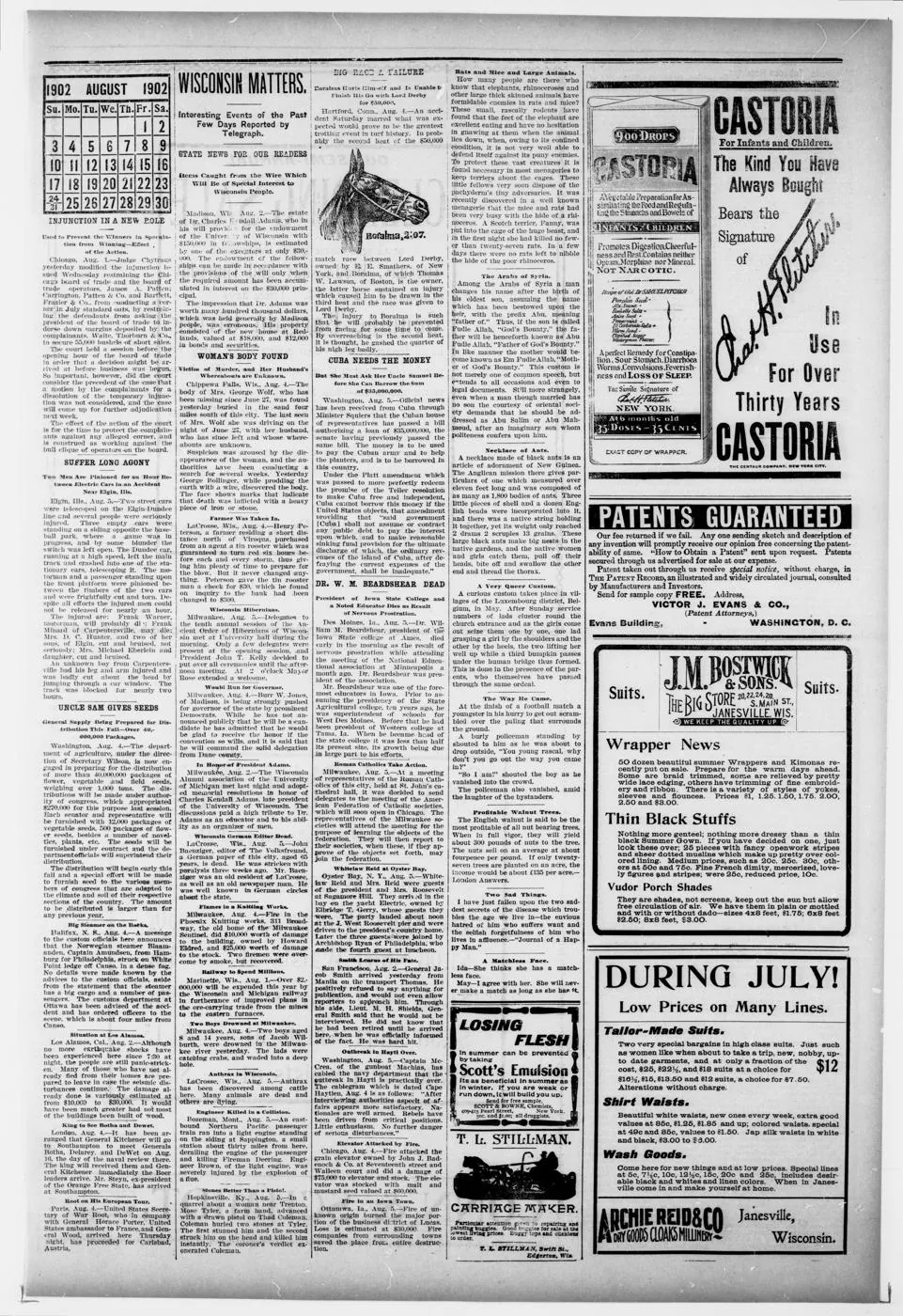
The collision took place on August 5, 1902, on the Elgin-Dundee Line, an interurban streetcar route connecting the cities of Elgin and Dundee, Illinois. At the time of the accident, three empty cars were standing on a siding opposite a baseball park along the route. A switch had reportedly been left open due to a blunder — the precise nature of the error and the party responsible are not specified in available sources — allowing an oncoming Dundee-bound car traveling at high speed to leave the main track and strike the stationary cars. The resulting telescoping collision trapped two men between the cars for nearly an hour and blocked the track for approximately two hours before service could resume. (Source: wisconsin-tobacco-reporter-1902-08-08)
The accident was reported in The Wisconsin Tobacco Reporter of Edgerton, Wisconsin, on August 8, 1902 — three days after the event — suggesting the story circulated beyond the immediate local press and was picked up by regional papers during the week following the collision. (Source: wisconsin-tobacco-reporter-1902-08-08)
Participants
The following individuals were identified in connection with the accident:
Critically Injured
- Frank Warner — Motorman of the Dundee car at the time of the collision. Warner was pinioned between the cars for nearly an hour. According to the source, he "will probably die," though no subsequent reporting on his condition has been located in currently available records. (Source: wisconsin-tobacco-reporter-1902-08-08)
- Frank Minajd — A passenger reportedly from Carpentersville, Illinois. Minajd was also trapped between the cars for nearly an hour alongside Warner. The source characterizes his prognosis as "may die." (Source: wisconsin-tobacco-reporter-1902-08-08)
Less Seriously Injured
- Mrs. D. C. Hunter — A passenger from Elgin. Described as cut and bruised but not seriously injured. (Source: wisconsin-tobacco-reporter-1902-08-08)
- Mrs. Michael Eberlein — A passenger whose place of origin is not given in the source. Also described as cut and bruised. (Source: wisconsin-tobacco-reporter-1902-08-08)
- An unidentified boy — Reportedly from Carpentersville. The boy sustained injuries to a leg and an arm and was badly cut about the head, apparently as a result of jumping through a car window during or immediately after the collision. His name was not recorded in the available source. (Source: wisconsin-tobacco-reporter-1902-08-08)
Significance
The 1902 streetcar accident highlights the safety hazards that accompanied rapid expansion of interurban rail service in northern Illinois during the Progressive Era. The Elgin-Dundee line, like many such routes of the period, operated cars at speeds that left little margin for error when switches were improperly set or equipment was left on the track without adequate warning. The fact that two men were pinioned between cars for nearly an hour before being freed underscores the limited emergency response capacity available along rural interurban routes at the time.
The accident also reflects the broader social geography of the Fox River corridor: passengers traveling the line came from communities including Elgin, East Dundee, and Carpentersville, suggesting the line served as a significant connector for daily movement across the region. The proximity of the accident site to a baseball park hints at leisure travel as one component of ridership on summer weekends, a pattern common to interurban lines of the era.
The ultimate fates of Frank Warner and Frank Minajd — the two most critically injured — are not known from sources currently held in The Kiln's collection. Further research in Elgin-area newspapers from August and September 1902 may yield additional detail.
Sources
- The Wisconsin Tobacco Reporter (Edgerton, Wis.), August 8, 1902, Image 3. Library of Congress, Chronicling America. https://www.loc.gov/resource/sn86086586/1902-08-08/ed-1/?sp=3