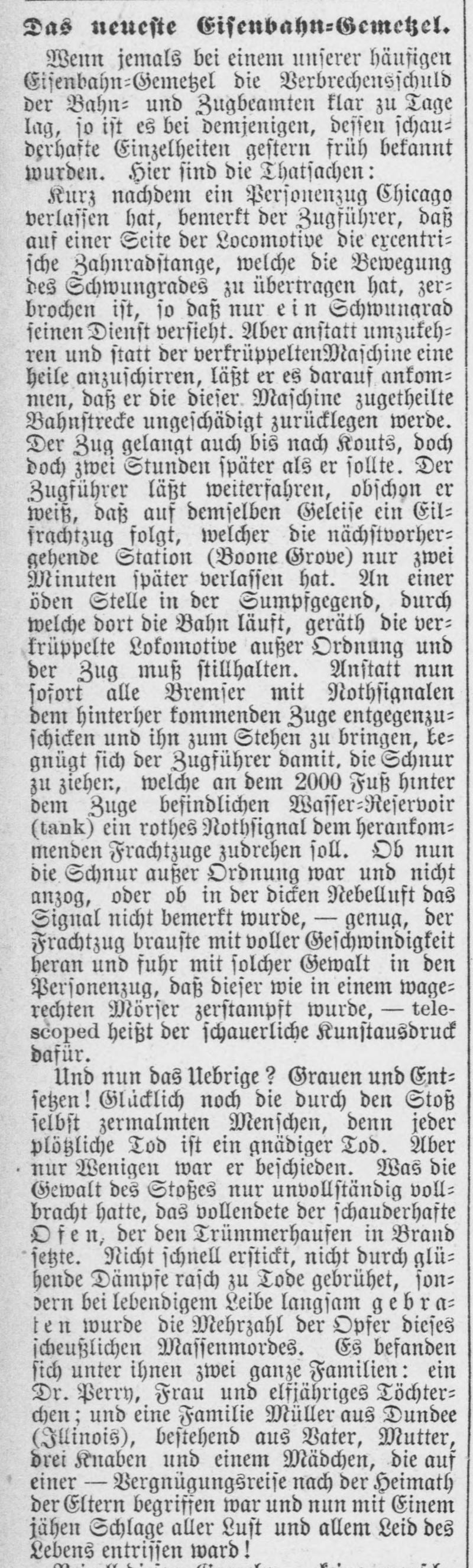
!Scanned newspaper page from Image 6 of The Mitchell capital (Mitchell, Dakota [S.D.]), October 14, 1887, 1887-10-14 (Library of Congress, Chronicling America) Scanned newspaper page from Image 6 of The Mitchell capital (Mitchell, Dakota [S.D.]), October 14, 1887, reporting on the Kouts railroad wreck and identifying victims from Dundee, Illinois by name (Library of Congress, Chronicling America) | Source: Library of Congress, Chronicling America
Date & Context
The collision occurred on October 16, 1887, and was reported in the Illinois Staats-Zeitung (Chicago) on October 17, 1887. (Source: Illinois Staats-Zeitung, October 17, 1887 (Chronicling America))
⚠️ CONTRADICTION: The Illinois Staats-Zeitung places the collision on October 16, 1887. The Mitchell capital (Mitchell, Dakota [S.D.]), published October 14, 1887, reports on the same Kouts wreck and dates the accident to October 12, 1887. The two sources cannot be fully reconciled on this point; both dates are preserved here pending additional documentation. (Sources: Illinois Staats-Zeitung, October 17, 1887 (Chronicling America); The Mitchell capital, October 14, 1887 (Chronicling America))
The passenger train had originated in Chicago and was carrying, among others, families traveling for personal purposes. The Müller family was reportedly making a pleasure trip to the homeland of the parents at the time of the disaster. (Source: Illinois Staats-Zeitung, October 17, 1887 (Chronicling America))
The mechanical circumstances leading to the collision appear to have been a combination of equipment failure and a crew decision to continue operating a damaged locomotive rather than return for repairs. According to the source, the passenger train's locomotive had a broken eccentric gear on the wheel mechanism — described as one non-functioning flywheel — when it departed Chicago. Despite this known damage, the crew chose to proceed. The train subsequently arrived at Kouts station two hours behind schedule, suggesting the mechanical impairment was significantly slowing progress. (Source: Illinois Staats-Zeitung, October 17, 1887 (Chronicling America))
At some point after the Kouts stop, the disabled locomotive failed entirely, leaving the passenger train stranded in a remote, swampy area. Meanwhile, a freight train had departed Boone Grove station only two minutes after the passenger train had cleared its previous station — a dangerously narrow interval. The train crew reportedly attempted to warn the approaching freight train using a rope mechanism connected to a signal at a water tank approximately 2,000 feet behind the stopped passenger train, but the emergency signal failed to halt the oncoming train. The freight train struck the passenger train at full speed. Fire broke out in the wreckage and, according to the source, burned many victims alive. (Source: Illinois Staats-Zeitung, October 17, 1887 (Chronicling America))
A passenger account reported in The Mitchell capital describes the violence of the collision in vivid terms: the impact overturned a stove in the coach, and fire spread rapidly through the car via a gas lamp, trapping and burning multiple passengers in the wreckage. (Source: The Mitchell capital, October 14, 1887 (Chronicling America))
Participants
Victims
The Müller / Miller Family — Residents of Dundee, Illinois, the family was entirely killed in the disaster. The Illinois Staats-Zeitung identifies them collectively as the father, mother, three boys, and one girl, without recording given names. (Source: Illinois Staats-Zeitung, October 17, 1887 (Chronicling America)) The Mitchell capital provides the family's given names: Charles Miller (father), Mrs. Lena Miller (mother), Fred Miller, William Miller, and Herman Miller (sons), and Minnie Miller (daughter) — six members in total, all of Dundee, Illinois. (Source: The Mitchell capital, October 14, 1887 (Chronicling America)) The surname is rendered as "Müller" in the German-language Staats-Zeitung and as "Miller" in the English-language Mitchell capital; these almost certainly refer to the same family.
Dr. Perry / Dr. William Perry — Also killed in the collision, along with his wife and his 11-year